
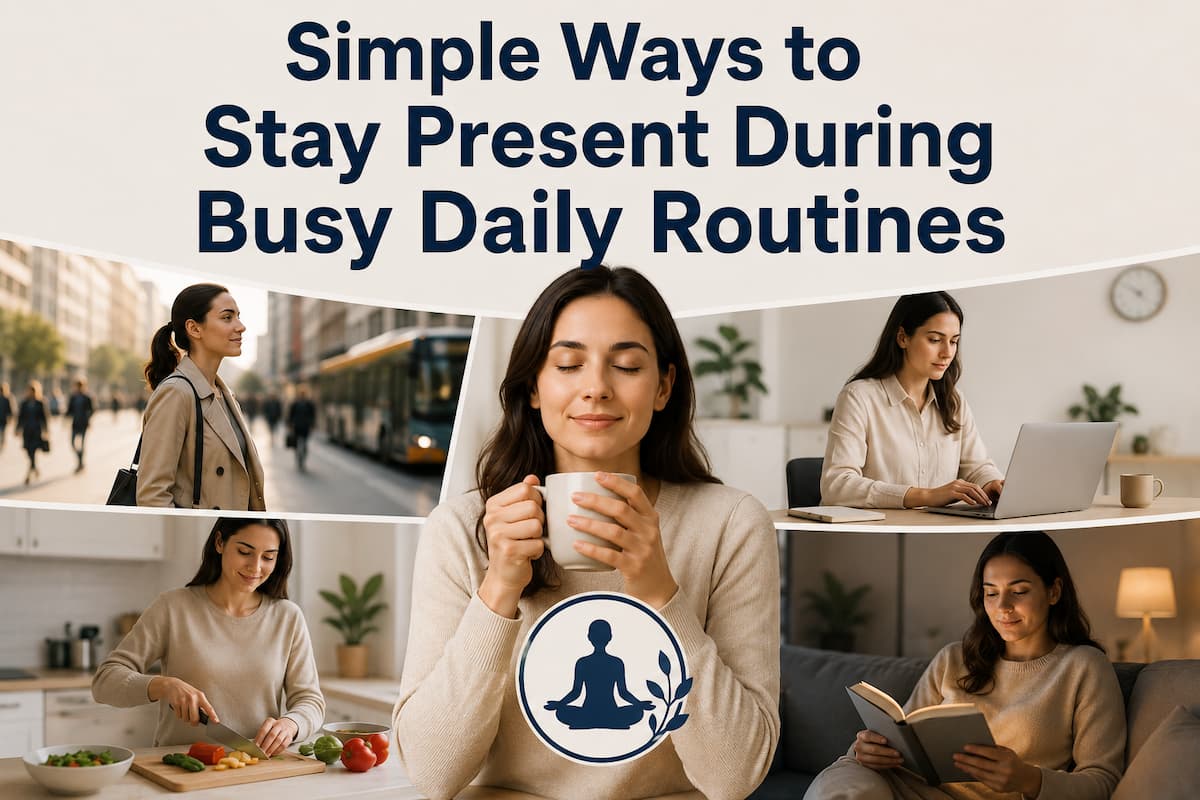
You don’t need to sit cross-legged on a cushion to be mindful. You don’t need an hour of silence or a retreat in the mountains. Presence isn’t a luxury reserved for people with empty calendars. It’s a skill you can build in the middle of your busiest day—while commuting, cooking, or answering emails.
The problem isn’t that you’re too busy to be present. The problem is you’ve been told presence requires stillness. It doesn’t. It just requires attention. And attention is something you can redirect at any moment.
What “Being Present” Actually Means
Let’s clear something up. Being present doesn’t mean your mind goes blank. It doesn’t mean you stop thinking about your to-do list or your worries. It means you’re aware of what’s happening right now—your breath, your body, the sounds around you—while those thoughts float by.
Think of it like watching traffic from a window. The cars (your thoughts) keep moving. You don’t jump in front of them. You just notice them passing.
That’s presence. Simple. Not always easy, but simple.
The Shower Test
Here’s a quick way to check how present you actually are. Next time you shower, try to remember what you thought about. Most people can’t. They were rehearsing a conversation, planning dinner, or worrying about something that happened yesterday.
The water was running. The soap was in their hand. Their bodies were there. Their minds were somewhere else entirely.
This isn’t a failure. It’s just a habit. And like any habit, it can be changed.
Why Busy People Need Presence More Than Anyone Else
When your schedule is packed, your mind becomes a pinball machine. One thought bounces into another, and before you know it, you’ve spent an entire meeting thinking about your grocery list. Or an entire evening with your family mentally drafting tomorrow’s emails.
This mental multitasking doesn’t make you more productive. It makes you less effective at everything you’re doing. Studies show that divided attention reduces performance on both tasks. You’re not doing two things well. You’re doing two things poorly.
Presence is the antidote. Not because it slows you down, but because it brings your full capacity to whatever you’re doing right now.
Practical Techniques for Real Life
The following techniques aren’t theoretical. They’re designed for people who don’t have time to meditate. People who are cooking dinner while helping with homework and answering a text. People like you.
1. The Three-Breath Reset
This takes about 20 seconds. You can do it anywhere. In a meeting, at a red light, before you open your laptop.
How it works:
- Take one deep breath in through your nose. Notice the air entering your body.
- Exhale slowly through your mouth. Feel your shoulders drop.
- Repeat twice more.
- That’s it. You’re back in your body.
The breath is always available. You don’t need an app. You don’t need silence. You just need to remember to use it.
2. Sensory Anchoring
Your senses are a direct line to the present moment. When your mind is racing, pick one sense and focus on it for 30 seconds.
Examples:
- Sight: Look at one object and describe it in detail. The color, the texture, the way light hits it.
- Sound: Close your eyes and identify three sounds you can hear right now.
- Touch: Feel the weight of your feet on the floor. The fabric of your clothes against your skin.
- Smell: Notice any scents in the air. Coffee, soap, rain, nothing at all.
- Taste: If you’re eating, slow down and actually taste your food. Not just the flavor, but the temperature, the texture.
This isn’t about having a spiritual experience. It’s about interrupting the spiral of thoughts and grounding yourself in what’s real.
3. The Transition Pause
Most of us move from one task to the next without a breath in between. We finish a meeting and immediately check email. We walk through the door and start dinner before we’ve taken off our shoes.
A transition pause is a deliberate gap between activities. It doesn’t need to be long. Thirty seconds is enough.
Before you start your next task, stop. Take a breath. Notice where you are. Then begin.
This small act prevents the mental clutter of one task from spilling into the next. It creates clean boundaries in your day.
4. Single-Tasking as a Practice
Multitasking is a myth. Your brain doesn’t do multiple things at once. It switches rapidly between them, and each switch costs you focus and energy.
Single-tasking is the practice of doing one thing at a time, with your full attention. It sounds simple, but in a world of notifications and interruptions, it’s a radical act.
Start small:
- Eat one meal without looking at your phone.
- Have one conversation without planning your response while the other person is still talking.
- Wash the dishes and only wash the dishes. Feel the water, the soap, the motion of your hands.
These moments of full attention, scattered throughout your day, add up to something significant. They train your brain to be present.
5. The Body Scan Check-In
Your body holds tension you don’t even notice. Clenched jaw. Tight shoulders. Held breath. These physical states signal stress to your brain, which then produces more stress thoughts, which creates more tension. It’s a loop.
A body scan check-in breaks that loop. Once an hour, or whenever you remember, do a quick scan from head to toe.
Quick version:
- Notice your jaw. Is it clenched? Let it soften.
- Notice your shoulders. Are they up by your ears? Let them drop.
- Notice your hands. Are they in fists? Open them.
- Notice your breath. Is it shallow? Take one deep belly breath.
This takes 15 seconds. But it interrupts hours of accumulated tension.
6. Mindful Listening
How often do you truly listen to someone? Not just hearing their words while you formulate your response, but actually receiving what they’re saying?
Mindful listening is one of the most powerful presence practices because it connects you to another person in real time. It requires you to drop your own agenda and be fully with them.
Try this:
- When someone is speaking, look at them.
- Don’t interrupt. Don’t plan what you’ll say next.
- Notice their tone, their pace, their body language.
- When they finish, pause before you respond. Let their words land.
This doesn’t just make you more present. It makes you a better friend, partner, parent, and colleague.
Building Presence Into Your Existing Routine
You don’t need to add “be present” to your to-do list. You need to attach presence to things you’re already doing.
This is called habit stacking, and it’s one of the most effective ways to build new behaviors without adding complexity to your day.
| What You Already Do | Presence Practice to Stack |
|---|---|
| Brush your teeth | Feel the toothbrush, the water, the mint. Don’t check your phone. |
| Make coffee or tea | Smell the grounds or leaves. Listen to the water heating. Watch the steam rise. |
| Commute to work | Put the podcast down for five minutes. Look out the window. Notice the sky. |
| Wait in line | Instead of scrolling, do a body scan. Notice your feet on the ground. |
| Open your laptop | Take one breath before you start. Set an intention for the session. |
| Walk to your car or transit | Feel the ground under your feet. Notice the temperature of the air. |
These aren’t extra tasks. They’re small shifts in attention during things you’re already doing.
What to Do When You Catch Yourself Drifting
You will drift. That’s guaranteed. Your mind will wander during a conversation, during a meal, during a meeting. This isn’t failure. It’s what minds do.
The practice isn’t about never drifting. It’s about noticing when you do, and gently bringing yourself back.
Think of it like training a puppy. You don’t yell at the puppy for wandering. You gently guide it back. Again and again. With patience.
Your mind is that puppy. Be gentle with it.
The Long Game: Why Small Moments Matter
You might think a 20-second breath reset or a mindful cup of coffee is too small to matter. It’s not.
Neuroscience research shows that repeated attention training changes the structure of your brain. The prefrontal cortex, responsible for focus and emotional regulation, becomes stronger. The amygdala, responsible for stress responses, becomes less reactive.
These changes don’t happen from one meditation retreat. They happen from thousands of small moments of attention, accumulated over time.
Every time you notice your mind has wandered and bring it back, you’re doing a rep. Just like lifting weights builds muscle, these reps build presence.
A Note on Guilt
Some people feel guilty when they try to be more present. They think about all the times they weren’t present with their kids, their partner, their work. They beat themselves up for being distracted.
Don’t do that. Guilt pulls you out of the present moment just as surely as worry does.
The past is gone. The future hasn’t arrived. The only moment you can actually be present in is this one. So be here now. That’s enough.
And when you forget again, which you will, start over. No drama. No judgment. Just return.
Your Presence Practice, Starting Now
You don’t need to overhaul your life. You don’t need a new app or a course or a book. You just need to start where you are, with what you have.
Pick one technique from this article. Just one. Try it today. Then try it again tomorrow. Let it become familiar before you add another.
Presence isn’t a destination. It’s a direction. You don’t arrive at it. You practice it. One breath, one moment, one day at a time.
And on the days when it feels impossible? That’s okay too. Show up anyway. That’s the practice.
Related Reading
If you found this helpful, these articles explore similar territory from different angles:
- How to Practice Mindfulness Without Sitting Still — For people who can’t or won’t meditate the traditional way.
- How to Listen Better in a World Full of Distractions — Deepening your connections through intentional attention.
- The Art of the Intentional Pause: Reclaiming 60 Seconds — Why micro-breaks matter more than you think.
- How to Create a More Mindful Daily Lifestyle — Building presence into the structure of your day.
- How to Use Movement to Reset Your Focus Mid-Day — When your mind is scattered, your body can bring you back.
- How to Eat Without Distraction and Why It Matters — One meal, fully experienced.
- How to Build Better Routines Without Feeling Overwhelmed — Systems that support presence without adding pressure.
- How to Recover From Mental Fatigue Without Napping — Restoring focus when your brain is fried.
References
- Kabat-Zinn, J. (1994). Wherever You Go, There You Are: Mindfulness Meditation in Everyday Life. Hyperion. — Foundational text on integrating mindfulness into daily activities.
- Hölzel, B. K., Carmody, J., Vangel, M., Congleton, C., Yerramsetti, S. M., Gard, T., & Lazar, S. W. (2011). “Mindfulness practice leads to increases in regional brain gray matter density.” Psychiatry Research: Neuroimaging, 191(1), 36-43. — Neuroimaging study showing structural brain changes from mindfulness practice.
- Rosen, C. (2008). “The myth of multitasking.” The New Atlantis, (20), 105-110. — Analysis of why multitasking reduces productivity and cognitive performance.
- Killingsworth, M. A., & Gilbert, D. T. (2010). “A wandering mind is an unhappy mind.” Science, 330(6006), 932-932. — Landmark study showing that mind-wandering correlates with unhappiness, regardless of activity.
- Tang, Y. Y., Hölzel, B. K., & Posner, M. I. (2015). “The neuroscience of mindfulness meditation.” Nature Reviews Neuroscience, 16(4), 213-225. — Comprehensive review of how attention training affects brain structure and function.
- Clear, J. (2018). Atomic Habits: An Easy & Proven Way to Build Good Habits & Break Bad Ones. Avery. — Habit stacking methodology referenced for integrating presence into existing routines.
Why we wrote this: We kept seeing articles about mindfulness that assumed you had 30 minutes of silence and a meditation cushion. Most people don’t. This article was written for the person rushing through their day, barely keeping up, who still wants to feel like they’re actually living their life—not just surviving it. If that’s you, we hope something here lands. And if it does, pass it along to someone else who needs it.
