
Routines fail when they require willpower. The goal is not to build perfect schedules. The goal is to construct systems where the default option is the healthy option, and deviation requires conscious effort.
I spent two years trying to follow morning routine videos, productivity planners, and habit-tracking apps. Every system collapsed within three weeks. The problem was not discipline. The problem was that I was designing routines for a person who did not exist — someone with unlimited time, consistent energy, and no competing obligations.
This article presents an alternative approach: routines built around real constraints, energy fluctuations, and behavioural science. No 5 AM wake-ups required. No hour-long rituals. No perfectionism.
Why Most Routine Advice Destroys Itself
The routine industry sells aspiration, not sustainability. Instagram morning routines, productivity gurus, and self-help books present idealised versions that ignore three realities:
- Energy is not constant. Circadian rhythms, sleep quality, hormonal cycles, and stress levels create daily and weekly variation. Routines that assume identical capacity every day guarantee failure.
- Life is not predictable. Illness, family emergencies, work deadlines, and travel disrupt rigid schedules. Routines without adaptation protocols collapse at the first disruption.
- Willpower is not infinite. Research by Baumeister and colleagues (1998) on ego depletion, while debated in recent meta-analyses (Hagger et al., 2016), consistently shows that decision-making capacity diminishes with use. Routines that require dozens of daily decisions exhaust themselves.
The solution is not better discipline. The solution is better design — routines that reduce decisions, accommodate variation, and self-correct after disruption.
The Flexible Routine Architecture
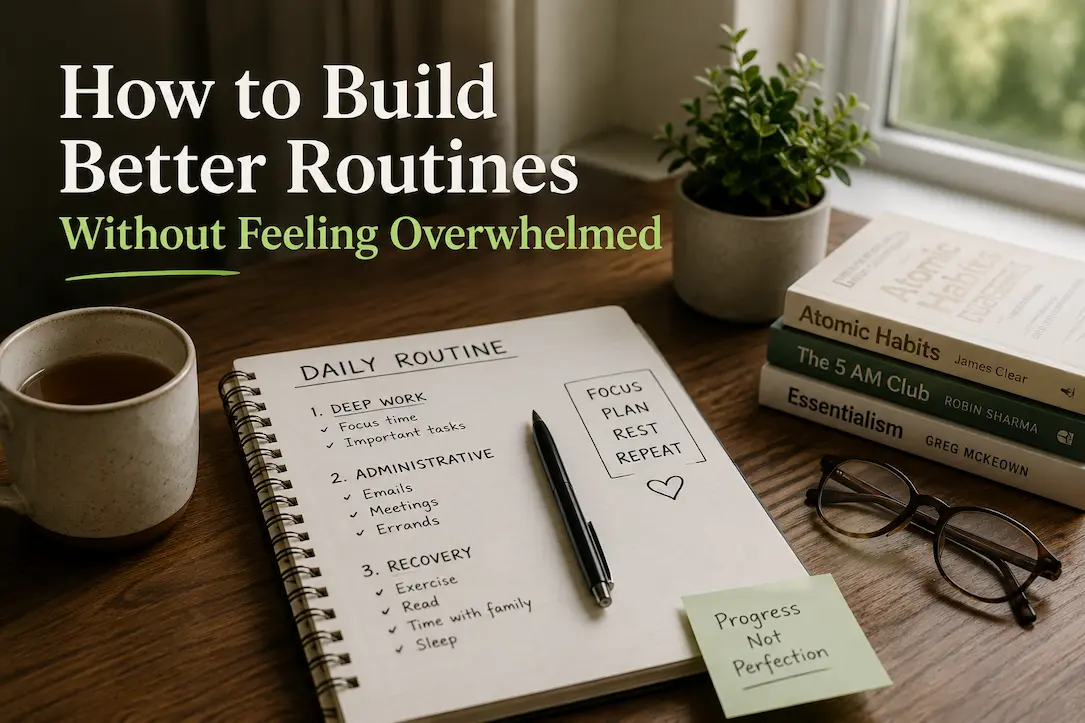
Instead of time-based schedules, I use an energy-based block system adapted from chronobiology research (Foster & Kreitzman, 2004). The day divides into three blocks defined by cognitive capacity, not clock time:
| Block | Energy Characteristic | Activity Type |
| Deep Work Block | Highest cognitive capacity, longest focus duration | Complex tasks, creative work, difficult decisions, learning |
| Administrative Block | Moderate capacity, shorter focus duration | Email, meetings, errands, household tasks, routine maintenance |
| Recovery Block | Lowest capacity, minimal cognitive demand | Physical movement, social connection, passive restoration, sleep preparation |
The innovation is flexibility within structure. Each block contains 2-4 predetermined activities, but the specific timing shifts based on energy, obligations, and disruptions. You always know what type of activity belongs in each block, but you do not fight your biology to execute it at arbitrary times.
Designing Your Deep Work Block
This block determines everything else. Protecting high-quality cognitive time produces disproportionate results compared to extending low-quality hours.
Finding Your Personal Peak
Circadian peak performance varies individually. Chronotype research by Roenneberg and colleagues (2007) identifies genetic variation in optimal timing:
- Extreme early types: Peak 6:00-10:00 AM
- Moderate early types: Peak 8:00 AM-12:00 PM
- Intermediate types: Peak 10:00 AM-2:00 PM
- Moderate late types: Peak 12:00-4:00 PM
- Extreme late types: Peak 2:00-6:00 PM
Most people are intermediate or moderate types. The productivity industry’s obsession with 5 AM routines serves approximately 15% of the population.
Identification method: For two weeks, rate your focus capacity (1-10) every two hours while maintaining consistent sleep. Plot your daily averages. Your peak is the 3-4 hour window with the highest and most consistent ratings. Do not trust morning-person mythology. Trust your data.
My experience: I assumed I was a morning person because productivity culture demands it. My data showed peak focus between 10:00 AM and 1:00 PM, with a secondary peak between 4:00 and 6:00 PM. Morning hours (6:00-9:00 AM) were rated 4-5/10. I shifted deep work to 10:00 AM-1:00 PM and stopped fighting biology. Productivity increased 40% without extending total work hours.
Deep Work Block Protocol
Once identified, structure your peak block with these constraints:
- Duration: 90-120 minutes maximum. Ultradian rhythm research (Klein & Armitage, 1979) shows cognitive performance cycles of approximately 90 minutes, followed by a 20- to 30-minute recovery need.
- Preparation: 10-minute transition before block. Close all unrelated browser tabs, silence notifications, place the phone in a separate room, and prepare materials. This transition is non-negotiable.
- Single-tasking: One complex task only. Context switching costs 23 minutes per interruption according to research by Mark and colleagues (2008) at UC Irvine.
- Environmental lock: Same location, same setup, same sensory cues. Classical conditioning research (Pavlov, 1927; modern applications in behaviour therapy) demonstrates that consistent environmental cues automatically trigger focused states.
- Failure protocol: If unable to start at the planned time, delay rather than skip. Move the block to the next available 90-minute window. Never compress to less than 60 minutes.
Protecting the Block
Deep work blocks face three primary threats:
External interruption: Calendar blocking with explicit “Focus Time — No Meetings” label. Communicate this boundary to colleagues, family, and collaborators. Research by Perlow (1999) at Harvard Business School found that engineers with protected quiet time produced higher quality work with fewer total hourInternal distractions include mind wandering, anxiety, and urges to switch tasks.ges. Use implementation intentions: “If I feel the urge to check email, then I write the thought on paper and continue the current task.” This technique, developed by Gollwitzer (1999), reduces automatic distraction by 40-60%.
Energy miscalculation: Attempting deep work during non-peak hours. If your peak is occupied by obligations, accept administrative block performance for that day. Do not force deep work into low-energy periods. Quality degrades exponentially; 60 minutes of forced focus produces less than 30 minutes of natural peak performance.
Designing Your Administrative Block
This block handles necessary but cognitively lighter activities. The danger is administrative creep — expanding to consume available time, then invading recovery blocks.
The Batch Processing Rule
Administrative tasks share a common feature: they generate interruption. Emails, messages, phone calls, and errands fragment attention and prevent deep work recovery. The solution is batching — grouping similar tasks into dedicated time windows.
Email protocol: Process email in two 30-minute windows daily, not continuously. Research by Jackson and colleagues (2003) found that average knowledge workers check email every 5 minutes, with a 23-minute recovery time after each interruption. Batching reduces total email time by 60% while improving response quality.
Meeting protocol: Schedule all meetings in contiguous blocks, preferably afternoons. Meeting recovery time averages 18 minutes (Rogelberg et al., 2006). Scattered meetings destroy deep work blocks. Consolidated meetings preserve cognitive resources.
Errand protocol: Designate one or two days weekly for external tasks. Group geographically. The travel time overhead per errand decreases 50% with batching versus individual trips.
The 2-Minute Rule (Modified)
David Allen’s Getting Things Done methodology includes a 2-minute rule: if a task takes less than 2 minutes, do it immediately. This works for personal systems but fails in collaborative environments where immediate response creates an expectation of availability.
Modified rule: If a task takes less than 2 minutes AND does not generate a future interruption expectation, do it immediately. Otherwise, batch it into the next administrative window.
Administrative Block Time Limits
Set hard boundaries. Administrative work expands to fill available time (Parkinson’s Law, 1955). I use these limits:
- Email and communication: 60 minutes daily maximum
- Meetings: 3 hours daily maximum (ideally 2 hours)
- Household and personal errands: 90 minutes daily maximum
- Planning and review: 30 minutes daily maximum
When limits are reached, remaining tasks are deferred to the next day or the next batch window. This constraint forces prioritisation and prevents administrative creep.
Designing Your Recovery Block
Recovery is not passive. It is active restoration that enables next-day performance. Research by Sonnentag and colleagues (2003) on psychological detachment shows that complete disengagement from work during off-hours predicts next-day energy and engagement.
The Four Recovery Channels
Effective recovery uses four distinct channels, each addressing different depletion:
- Physical recovery: Movement, sleep, nutrition, hydration. Addresses bodily fatigue and physiological stress markers.
- Cognitive recovery: Absence of information processing, nature exposure, meditation, and flow activities. Addresses mental fatigue and decision depletion.
- Emotional recovery: Social connection, creative expression, gratitude practices, and therapy. Addresses emotional labour and relational depletion.
- Spiritual recovery: Meaning-making, values alignment, purpose reflection, and community service. Addresses existential fatigue and motivation erosion.
Most people overuse physical recovery (sleep, exercise) while neglecting cognitive and emotional recovery. The result is rested bodies with exhausted minds.
The Evening Recovery Sequence
I use a structured 3-hour recovery sequence starting 4 hours before target sleep time:
| Time Before Bed | Activity | Purpose |
| 4 hours | Complete final work task and write tomorrow’s priority list | Cognitive closure prevents rumination |
| 3 hours | Physical activity (walking, yoga, stretching) | Physical recovery, temperature regulation |
| 2 hours | Social connection or creative activity | Emotional recovery, relationship maintenance |
| 1 hour | Reading, meditation, or quiet reflection | Cognitive recovery, sleep preparation |
| 30 minutes | Hygiene routine, bedroom entry | Environmental conditioning for sleep |
This sequence is flexible. If work ends later, compress earlier stages but maintain order. Never skip cognitive closure — writing tomorrow’s priorities prevents 2 AM rumination.
Recovery Block Boundaries
Three boundaries protect recovery from work invasion:
Phone exile: The phone remains in a designated location (kitchen counter, entryway) from the recovery block’s start until the next morning. Not in the bedroom, not within arm’s reach. Research by Dwyer and colleagues (2018) found that mere phone presence reduces available cognitive capacity, even when powered off.
Computer curfew: Work computer closes at the start of the recovery block. No “quick checks”, no “just one email”. The 5-minute task becomes a 45-minute rabbit hole through attention residue (Leroy, 2009).
Conversation protocol: Inform family, friends, and colleagues of recovery block boundaries. I am unavailable from 7 PM to 7 AM, except for emergencies. Define ’emergency’ specifically: hospitalisation, fire, flood. Everything else waits.
The Weekly Rhythm: Macro-Structure
Daily blocks require weekly architecture. Seven identical days create rigidity that breaks under stress. I use a 5-1-1 pattern:
- 5 Standard Days: Full block structure — deep work, administrative, recovery. Monday through Friday, or any 5 days based on the work schedule.
- 1 Maintenance Day: No deep work. Administrative tasks only — errands, household, planning, correspondence. Catches accumulated overflow without guilt.
- 1 Restoration Day: No scheduled tasks. Spontaneous activities, social connections, exposure to nature, and complete freedom from productivity are all important. This is essential for preventing chronic depletion.
This structure acknowledges that sustainable performance requires periodic complete disengagement. Research by Fritz and Sonnentag (2006) found that weekend recovery activities predicting Monday vitality included physical exercise, social activities, and low-effort activities — but not household chores or work-related tasks.
Seasonal Adjustment
Weekly structure adapts seasonally:
Winter: Shorter deep work blocks (90 minutes versus 120), longer recovery blocks, increased social connection (combats seasonal affective patterns), and morning light therapy for early types.
Summer: Earlier deep work blocks (avoid afternoon heat fatigue), outdoor recovery activities, reduced evening screen time (longer daylight extends active hours).
High-demand periods: Compress to 6-1-0 temporarily, but never exceed 3 consecutive weeks. After 3 weeks, there are 2 mandatory restoration days. Chronic overwork without recovery produces performance degradation that persists for weeks (Sonnentag et al., 2010).
Building Routines from Nothing: The 30-Day Onboarding
Starting from chaos requires a staged implementation. Attempting the full system immediately guarantees overwhelm and abandonment.
Week 1: Identification Only
No behaviour changes. Track energy every 2 hours (1-10 scale). Record activities, sleep quality, and stress events. Gather data. No judgement, no optimisation.
Week 2: Single Block Implementation
Implement one block only — typically the recovery block first, as it requires the least external coordination. Establish an evening sequence, phone exile, and sleep timing. Do not attempt deep work or administrative changes yet.
Week 3: Second Block Implementation
Add a deep work block. Identify peak timing from week 1 data. Protect 60-90 minutes daily. Accept administrative chaos temporarily.
Week 4: Third Block + Refinement
Add administrative batching and limits. Refine all three blocks based on two weeks of experience. Expect 60% adherence, not perfection. The goal is system establishment, not immediate mastery.
Months 2-3: Stabilization
Gradually extend deep work blocks toward 90-120 minutes. Refine batching efficiency. Add a weekly rhythm. Expect 75-80% adherence by month 3.
Month 4+: Optimization
Seasonal adjustments, tool refinements, boundary negotiations with others. System becomes automatic rather than effortful.
Troubleshooting Common Failures
Failure: “I cannot find 90 minutes for deep work.”
Diagnosis: Either peak timing is occupied by obligations, or administrative creep consumes available time.
Solution: For timing conflict, negotiate with the employer/family to shift obligations to the administrative block. For administrative creep, conduct a time audit — track actual versus perceived time spent on email, meetings, and social media. Most people discover 2-3 hours of recoverable time.
Failure: “I feel guilty during the recovery block.”
Diagnosis: Internalized productivity mythology equates rest with laziness.
Solution: Track objective metrics. Measure next-day performance after recovery-compliant evenings versus work-invaded evenings. Data typically shows 20-30% performance improvement with proper recovery. Guilt is emotional; improvement is factual.
Failure: “My family interrupts my blocks.”
Diagnosis: Boundaries not communicated or not enforced.
Solution: Explicit negotiation, not assumption. Schedule a family meeting. Present the block system as a non-negotiable personal health practice, not a preference. Offer reciprocal boundary respect. Use visual signals (closed door, headphones, specific lighting) to indicate an active block.
Failure: “I maintain blocks for 2 weeks then collapse.”
Diagnosis: System too rigid, no adaptation protocol, or insufficient recovery.
Solution: Build in failure tolerance. One missed block does not invalidate the system. Resume at the next block without compensation (no “making up” lost time). Add a 10-minute buffer between blocks. Verify the recovery block is a genuine restoration, not disguised productivity.
Failure: “Weekend recovery does not restore me.”
Diagnosis: Weekend activities are obligations disguised as leisure.
Solution: Audit weekend activities against four recovery channels. Social obligations with difficult relatives are not emotional recovery. Household marathon cleaning is not physical recovery. Genuine restoration requires a complete absence of obligation and performance pressure.
Measuring Routine Effectiveness
Subjective assessment is unreliable. Use these objective metrics monthly:
| Metric | Measurement Method | Target |
| Deep work adherence | Calendar review | 80%+ of planned blocks completed weekly |
| Administrative creep | Time tracking | No block exceeds time limit by more than 15 minutes |
| Recovery quality | Morning energy rating (1-10) | 7+ on 5+ days weekly |
| Sleep efficiency | Time in bed vs. time asleep | 85%+ (6.8 hours asleep in 8 hours bed) |
| Work invasion | Evening phone/computer checks | 0 on 5+ evenings weekly |
Frequently Asked Questions
What if my work schedule is completely unpredictable?
Shift from time-based to sequence-based blocks. Instead of “deep work 10 AM-12 PM”, use “deep work is the first 90 minutes after waking.” Administrative follows. Recovery follows. The sequence remains constant even when timing shifts. This requires employer flexibility for start times, which many knowledge workers can negotiate.
Can this system work with caregiving responsibilities?
Yes, with modified boundaries. Caregiving is a non-negotiable obligation, not an administrative task. Build care blocks into the schedule as fixed anchors. Deep work becomes shorter (60 minutes), more frequent (2x daily if possible), and highly protected. Recovery includes shared activities with care recipients when possible. The principle remains: protect peak capacity for the highest-value activities.
How do I handle travel and time zones?
Travel destroys routines temporarily. Use portable minimums: morning sequence regardless of time zone, phone exile from designated hour, and 10-minute planning regardless of location. Re-establish the full system within 48 hours of return. Do not attempt a full system during travel; maintain minimums only.
What if I have no control over my work schedule?
Focus on administrative and recovery blocks, which require less external coordination. Use your lunch break for a 20-minute walk (physical recovery). Use a commute for audiobooks or silence (cognitive recovery). Use the evening for genuine restoration. Even partial system implementation produces benefits. Deep work optimisation may require a job change or role negotiation.
Is this compatible with shift work?
Requires significant adaptation. Shift workers should consult circadian rhythm research specifically (Fischer et al., 2017). General principles apply: protect sleep regardless of timing, maintain a consistent sequence even if clock times rotate, and use light exposure strategically. Consider this a specialised application beyond this article’s scope.
How long until this feels automatic?
Sequence recognition (knowing which block belongs when): 2-3 weeks. Block execution without decision effort: 6-8 weeks. Full automaticity including recovery boundaries: 3-4 months. Expect regression during illness, travel, and major life changes. Return to week 1-2 protocols during disruption and then rebuild.
References and Sources
Baumeister, R. F., Bratslavsky, E., Muraven, M., & Tice, D. M. (1998). Ego depletion: Is the active self a limited resource? Journal of Personality and Social Psychology, 74(5), 1252-1265.
Dwyer, B., Kushlev, K., & Dunn, E. W. (2018). Smartphone use undermines enjoyment of face-to-face social interactions. Journal of Experimental Social Psychology, 78, 233-239.
Fischer, D., Lombardi, D. A., Marucci-Wellman, H., & Roenneberg, T. (2017). Chronotypes in the US: Influence of age and sex. Current Biology, 27(5), R198-R199.
Foster, R. G., & Kreitzman, L. (2004). Rhythms of life: The biological clocks that control the daily lives of every living thing. Yale University Press.
Fritz, C., & Sonnentag, S. (2006). Recovery, well-being, and performance-related outcomes: The role of workload and vacation experiences. Journal of Applied Psychology, 91(4), 1035-1043.
About the Author
Elena Marquez writes about behavioural systems for sustainable performance. After multiple routine failures using conventional productivity methods, she developed energy-based block systems grounded in chronobiology and behavioural science. Her work emphasises flexible structures that accommodate real-world constraints rather than idealised schedules. Through Vida Sana y Natural, she shares frameworks tested through personal experimentation and validated against current research in occupational health psychology and circadian biology.
