
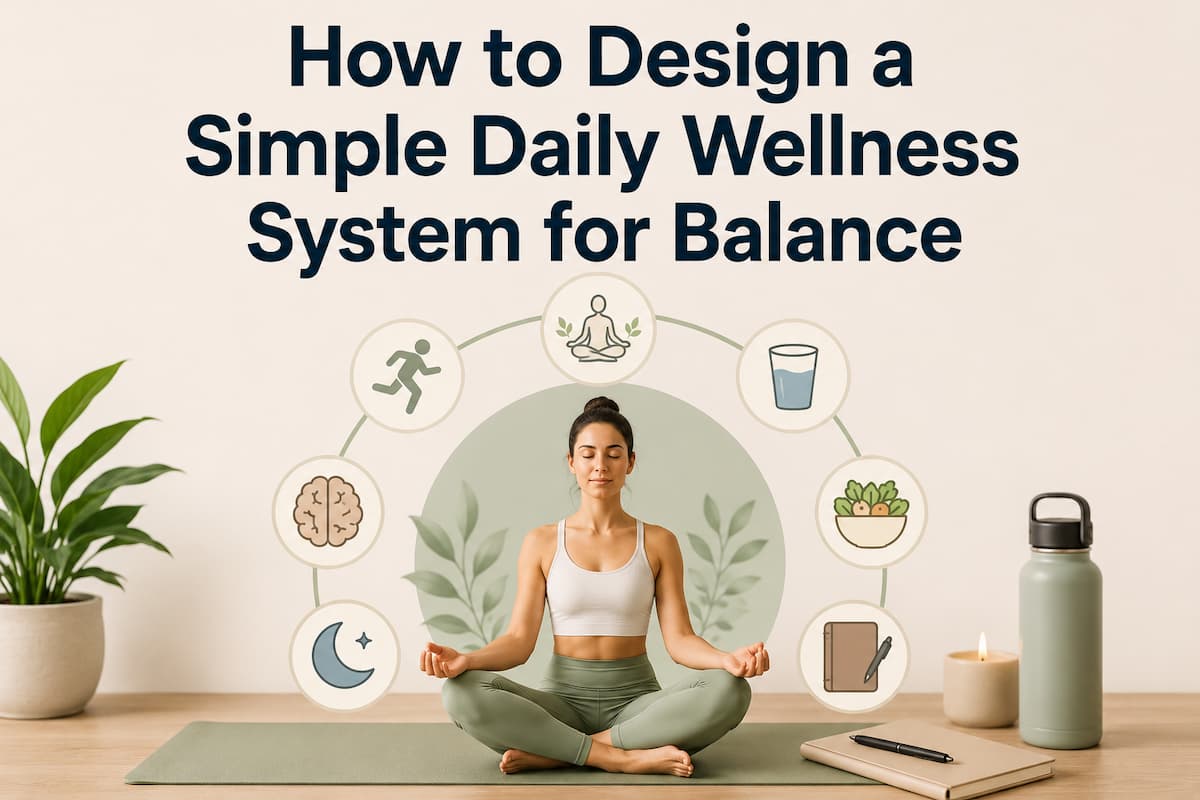
Some days feel like you’re juggling too many plates. Other times, you’re staring at the ceiling, wondering where the time went. What if the answer isn’t doing more, but building a system that holds itself together?
The Problem With “Wellness” Today
We’ve been sold the idea that balance requires perfection. A 5 AM wake-up. A green smoothie. Meditation. A workout. Journaling. Cold showers. By 7 AM, you’re supposed to be a different person.
But here’s what nobody tells you: most wellness routines fail because they’re built like sprints, not systems.
A system, by definition, is something that runs with minimal friction. It doesn’t rely on motivation. It doesn’t punish you for missing a day. It just keeps the essential things moving.
This article is about building one of those. Not a rigid schedule. Not another checklist. A simple daily wellness system that actually fits your life.
What a Wellness System Actually Looks Like
Before we build anything, let’s get clear on what we’re aiming for. A wellness system isn’t about adding more to your plate. It’s about organizing what’s already there.
Think of it like this: your body and mind have basic needs—movement, rest, nourishment, connection, focus, and recovery. A system makes sure those needs get met without you having to think about them every single day.
| Wellness Category | What Your Body Actually Needs | Simple Daily Action |
|---|---|---|
| Movement | Blood flow, joint mobility, strength maintenance | 10-minute walk after lunch |
| Rest | Sleep quality, nervous system recovery | Same bedtime, 30-min wind-down |
| Nourishment | Steady energy, blood sugar stability | Protein at every meal |
| Focus | Mental clarity, reduced decision fatigue | One intentional pause mid-day |
| Connection | Emotional regulation, sense of belonging | One real conversation, no screens |
| Recovery | Mental fatigue repair, stress processing | 5 minutes of unstructured quiet |
The beauty of this approach? You’re not chasing six different goals. You’re building one system that touches all of them.
Step One: Pick Your Anchor Habit
Every system needs an anchor. This is the one thing that, when it happens, everything else becomes easier.
For some people, it’s sleep. When they sleep well, they eat better, move more, and think more clearly. For others, it’s movement—a morning walk sets the tone for the whole day. For you, it might be something entirely different.
Quick Check: What’s the one habit that, when you do it consistently, makes everything else feel manageable? Not the fanciest habit. Not the one you think you “should” do. The one that actually moves the needle for you.
Once you identify your anchor, protect it. Build your system around it. Everything else is secondary.
Step Two: Design Three Transition Moments
Most of us treat our days like one long block of time. But your brain doesn’t work that way. It operates in phases, and the transitions between those phases matter more than you think.
A transition ritual is a short, repeatable action that signals to your brain: “We’re moving into a different mode now.”
Here are three transitions worth designing:
Morning → Work Mode
This doesn’t need to be elaborate. It could be making your bed, brewing coffee, and sitting down with a single intention for the day. The point is consistency, not complexity.
Work Mode → Evening
This is where most people struggle. You close your laptop and immediately feel the weight of unfinished tasks. A transition ritual—like a short walk, changing clothes, or even a specific playlist—creates a boundary between work and rest.
Evening → Sleep
Your brain needs a runway to land. Dimming lights, putting screens away, or a few minutes of reading tells your nervous system it’s time to wind down.
Step Three: Build in Strategic Recovery
Here’s a counterintuitive truth: rest isn’t the opposite of productivity. It’s part of it.
Your brain has a limited amount of focused attention each day. Push past that limit, and you’re not working harder—you’re working worse. The quality of your output drops, your stress rises, and you end the day feeling drained instead of accomplished.
Strategic recovery means planning breaks before you need them. Not scrolling on your phone. Real recovery—movement, nature, quiet, or something that genuinely recharges you.
Try this: Set a timer for 90 minutes of focused work, followed by a 10-minute break. During that break, step away from your desk. Look out a window. Stretch. Breathe. Then come back. You’ll be surprised how much more you get done.
Step Four: Make Your Environment Work For You
Willpower is overrated. Your environment shapes your behavior far more than your intentions do.
If you want to move more, keep your shoes by the door. If you want to eat better, keep healthy food visible and accessible. If you want to sleep better, make your bedroom a screen-free zone.
Environment Design Tip: Look at the spaces where you spend the most time—your desk, your kitchen, your bedroom. What’s one small change that would make the healthy choice the easy choice? Start there.
Lighting matters too. Bright, cool light in the morning helps you wake up. Warm, dim light in the evening helps you wind down. It’s not about buying expensive fixtures. It’s about being intentional with what you already have.
Step Five: Track Without Obsessing
Tracking can be helpful. It can also become a source of anxiety if you’re not careful.
The goal isn’t perfection. The goal is awareness. A simple check-in at the end of each day—”Did I move? Did I rest? Did I eat well?”—is often enough.
Some people like apps. Others prefer a notebook. There’s no right answer. What matters is that tracking serves you, not the other way around.
If you find yourself stressed about missing a day, that’s a sign your system is too rigid. Scale back. Simplify. The best wellness system is the one you can maintain when life gets messy.
Step Six: Embrace the Boring Days
Not every day needs to be exciting. In fact, the most sustainable wellness systems are built on boring routines.
The same breakfast. The same walk. The same bedtime. It sounds monotonous, but it’s actually freeing. When your basics are automated, you have mental energy left for everything else.
Excitement isn’t the goal. Consistency is. And consistency, over time, produces results that no burst of motivation ever could.
Putting It All Together: A Sample Day
Here’s what a simple wellness system might look like in practice. Not as a template to copy, but as an example of how the pieces fit together.
| Time | Action | Purpose |
|---|---|---|
| 7:00 AM | Wake up, open curtains, drink water | Light exposure + hydration |
| 7:15 AM | 10-minute stretch or walk | Movement + transition to day |
| 12:30 PM | Lunch away from screens | Nourishment + mental break |
| 3:00 PM | 5-minute walk or stretch | Energy reset + movement |
| 6:00 PM | Close laptop, change clothes | Work-to-home transition |
| 9:00 PM | Dim lights, put phone away | Wind-down signal |
| 10:00 PM | Bedtime | Consistent sleep schedule |
Remember: This is just one possible day. Your system should look different because your life is different. The principles matter more than the specifics.
What to Do When the System Breaks
It will break. That’s not pessimism—it’s reality.
Sick days. Travel. Deadlines. Family emergencies. Life happens, and your wellness system won’t survive every disruption. The question isn’t whether it will break. The question is how quickly you can get back to it.
Here’s the trick: don’t restart everything at once. Pick one anchor habit. Get that back. Then add the next. Rebuilding slowly is faster than burning out trying to do it all at once.
Also, give yourself permission for “good enough.” A 10-minute walk is better than no walk. A protein bar is better than skipping a meal. A few hours of sleep is better than none. Perfection is the enemy of consistency.
The Real Measure of Success
A wellness system isn’t working if you’re more stressed than when you started. The whole point is to feel better, not to add another source of pressure.
So check in with yourself honestly. Are you sleeping better? Do you have more steady energy? Are you less reactive to stress? Those are the metrics that matter.
Not how many habits you checked off. Not whether your routine looks Instagram-worthy. Just: Do you feel more like yourself?
That’s the goal. Everything else is noise.
Related Articles You Might Find Helpful
If you’re building out your wellness system, these articles from our site dive deeper into specific pieces of the puzzle:
- How to Design a Morning Routine Space That Actually Works — A practical guide to setting up your environment for a better start to the day.
- How to Create a Better Wind Down Routine at Night — Because how you end your day matters as much as how you start it.
- How to Build a Transition Ritual Space Between Work and Home — Learn how to create real boundaries when your office is your living room.
- The Science of Strategic Breaks and Why Most People Take the Wrong Ones — Breaks aren’t slacking off. Done right, they’re a performance tool.
- How to Track Your Habits Without Becoming Obsessed — Tracking should help, not haunt you.
- Simple Ways to Stay Consistent With Healthy Habits: A Behavioral Science Approach — The psychology behind why some habits stick and others don’t.
- Natural Ways to Maintain Steady Energy Throughout the Day — No caffeine crash required.
- The Case for Boring Routines and Why Excitement Isn’t the Goal — Why monotony might be your secret weapon.
- How to Create a More Relaxing Home Environment — Your space shapes your state of mind more than you realize.
- Why Self-Care Routines Fail and How to Build Ones That Don’t — If you’ve tried and quit before, this one’s for you.
Sources and References
- Clear, J. (2018). Atomic Habits: An Easy & Proven Way to Build Good Habits & Break Bad Ones. Avery. — Framework for habit stacking and environment design.
- Walker, M. (2017). Why We Sleep: Unlocking the Power of Sleep and Dreams. Scribner. — Research on sleep quality, circadian rhythms, and recovery.
- Newport, C. (2016). Deep Work: Rules for Focused Success in a Distracted World. Grand Central Publishing. — Principles of focused work and strategic breaks.
- Trougakos, J. P., & Hideg, I. (2009). “Momentary work recovery: The role of within-day work breaks.” Research in Organizational Stress and Well-being, 7, 37-84. — Evidence for structured break intervals improving performance.
- Thaler, R. H., & Sunstein, C. R. (2008). Nudge: Improving Decisions About Health, Wealth, and Happiness. Yale University Press. — Behavioral science approach to environment design and choice architecture.
- Lally, P., van Jaarsveld, C. H. M., Potts, H. W. W., & Wardle, J. (2010). “How are habits formed: Modelling habit formation in the real world.” European Journal of Social Psychology, 40(6), 998-1009. — Research on habit formation timelines and consistency.
About this article: This piece was written because we noticed a pattern: people come to our site looking for specific tips (better sleep, more energy, less stress) but often leave without the bigger picture. A wellness system ties those pieces together. The goal here was to give you a framework you could actually use—something flexible enough for real life, not just ideal conditions. If you found it helpful, share it with someone who’s been trying to “get it together” and feeling like they’re falling short. They’re probably closer than they think.
