
Last Updated: June 1, 2026 | Reading Time: 7 minutes
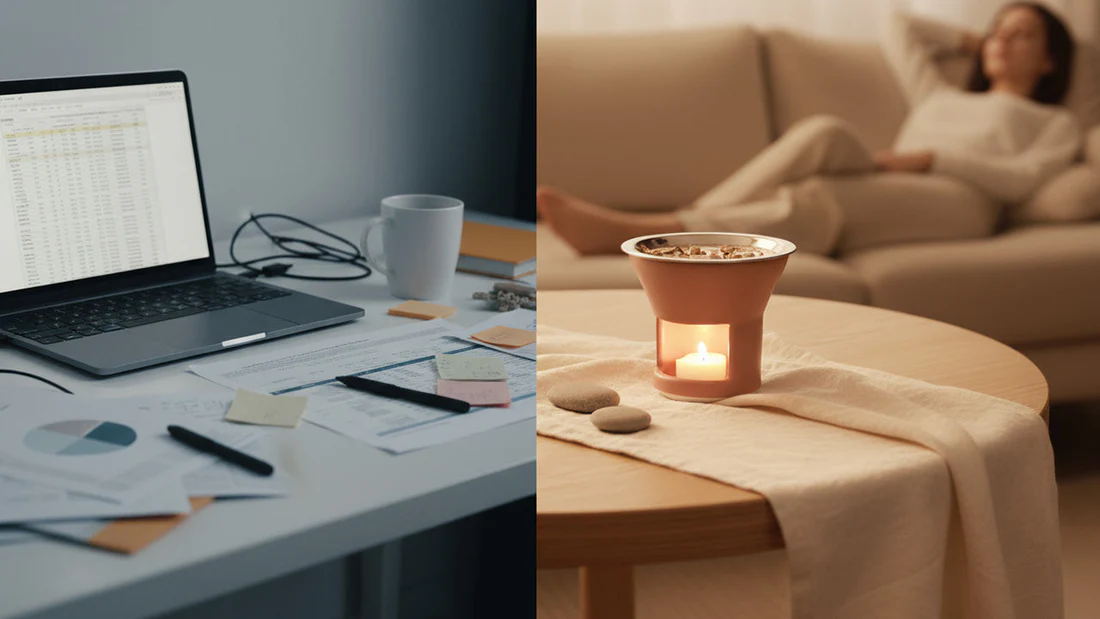
At 5:47 PM, you close your laptop. You stand up from the desk that has been your office, your conference room, and your lunch spot for the last nine hours. You walk ten feet to your kitchen. You pour a glass of water. You stand there for a moment, unsure what comes next. The workday has ended, but you haven’t been released. Your mind is still in your inbox. Your shoulders are still tight from the last meeting. The boundary between professional stress and personal peace has dissolved into nothing.
This is the invisible wound of remote and hybrid work. It is not the isolation nor the Zoom fatigue, but rather the erasure of transition that is the issue. When you commuted, that drive or train ride was a ritual. It forced a pause between identities. You left the office persona in the car and arrived home as yourself. Now, the shift from worker to person occurs in a hallway, and often, it doesn’t happen at all.
What you need is not a longer commute. You need a space that performs the same function: a physical and psychological threshold between work and everything else. A transition ritual space. This article explores why that space matters, what it should contain, and how to build one in any home, regardless of size or layout.
The Cost of a Boundaryless Day
Without a clear transition, work bleeds into the evening, and evening bleeds into sleep. Your nervous system never fully downshifts. Cortisol that spiked during a 3 PM deadline stays elevated through dinner. Mental rumination that began with a difficult email continues through your child’s bedtime story. You are physically present at home but psychologically still at work.
The research on this phenomenon is unequivocal. A 2021 study from the University of California, Irvine, found that remote workers who lacked clear boundaries between work and personal life reported significantly higher levels of emotional exhaustion and lower job satisfaction. The absence of a physical transition—no office door to close, no commute to complete—was the strongest predictor of this boundary violation.
But the damage extends beyond work satisfaction. When your brain never receives a clear signal that the workday is over, it maintains a low-grade vigilance that interferes with recovery. You sleep less deeply. You enjoy leisure less fully. You bring residual tension into conversations with people you love. The cost is not professional. It is relational, emotional, and physical.
A transition ritual space interrupts this bleed. It creates a firm stop. When you enter this space, you perform a series of actions that tell your brain: work is complete. The vigilance can end. The recovery can begin. It is not about relaxation, exactly. It is about permission.
What a Transition Space Actually Is
A transition ritual space is not a home office. It is not a meditation room. It is not a gym or a bar cart or a reading nook, though it might borrow elements from all of these. It is, above all, a threshold—a defined area where one version of yourself ends and another begins.
The space can be as small as a single chair by a window or as large as a dedicated room. What matters is not size but intention. The space must be used exclusively for the transition ritual. You do not work there. You do not scroll your phone there. You do not dump laundry there. It is reserved for the specific sequence of actions that mark the end of your workday and the beginning of your personal time.
This exclusivity is what gives the space its power. Your brain forms strong associations between environments and behaviours. When a space is used for multiple purposes, those associations blur and weaken. When a space is reserved for a single, meaningful ritual, the association becomes potent. Entering the space automatically triggers the mental shift you are trying to create.
The ritual itself can be simple or elaborate, depending on your needs and your nature. Some people need five minutes of structured activity. Others need thirty. The key is consistency. The same space, the same sequence, and the same time each day. Repetition is what turns a space into a trigger.
Designing the Space: The Five Elements
Every effective transition ritual space contains five elements, whether explicitly or implicitly. You do not need to force all five into a tiny corner, but understanding them helps you prioritise what matters most in your situation.
Firstperform a physical action that symboliseses closure. This is the centrepiece of the ritual. It must involve your body, not just your mind, because the body leads the brain more reliably than vice versa. Common examples include changing clothes, washing your face, lighting a candle, or writing a brief end-of-day note. The action should be deliberate and sensory. You should feel it, smell it, or see it clearly.
Changing clothes is particularly powerful because it is a literal shedding of identity. The work shirt comes off. The comfortable sweater goes on. This is not about laziness or comfort. It is about signalling to yourself that the professional persona is no longer needed. If you do not have the option to change fully, even removing shoes and putting on slippers can serve this function.
Second, consider a sensory shift that contrasts with your work environment. If your workspace is bright, cool, and visually busy, your transition space should be dim, warm, and visually simple. If your workspace is silent or filled with video call voices, your transition space might include music, nature sounds, or intentional silence. The contrast creates a neurological boundary. Your brain registers the difference and begins to shift states.
Lighting is the most accessible sensory shift. Swap the cool, bright bulbs of your work area for warm, dim lighting in your transition space. Salt lamps, candles, or string lights create an immediate atmosphere of safety and closure. The change in colour temperature alone is enough to begin reducing cortisol and preparing your nervous system for rest.
Third, an object that holds meaning. Rituals gain power from symbolism. A transition space should contain at least one object that represents what you are transitioning toward. This might be a family photo that reminds you of your values. A plant that represents growth and patience. A piece of art that calms your mind. A book you read for pleasure, not professional development.
This object is not decoration. It is an anchor. When your mind tries to drift back to work concerns, the object draws your attention to the present and to the life you are re-entering. It is a tangible reminder that work is a part of your life, not the whole of it.
Fourth, a boundary marker that separates the space from work areas. In a small apartment, such a marker might be a rug, a screen, or a specific wall. In a larger home, it might be a separate room or a garden path. The marker does not need to be physical, though physical boundaries are strongest. Even a consistent piece of music played only during the transition can serve as an auditory boundary.
The boundary marker performs a crucial psychological function. It creates the sense of crossing a threshold. Without this sense of crossing, the transition remains abstract and easily ignored. With it, the transition becomes felt and real.
Fifth, a time limit that prevents the ritual from becoming avoidance. The transition is not an escape from work responsibilities. It is a structured pause that allows you to return to those responsibilities tomorrow with more capacity. Set a clear duration for your ritual. Ten minutes. Twenty minutes. When the time is complete, the ritual is also complete. You move into your evening with full presence, not lingering on the threshold indefinitely.
Rituals That Work: Real Examples
The specific ritual you design depends on your personality, your living situation, and the nature of your work. Here are three examples that illustrate different approaches.
The Minimalist Transition: Sarah, a software engineer in a one-bedroom apartment, uses a single armchair by her balcony door. At 6 PM, she closes her laptop, walks to the chair, removes her shoes, and sits for exactly ten minutes. She does nothing. No phone, no book, no music. She watches the sky change. She feels her breathing slow. When the ten minutes pass, she stands up and begins her evening. Simplicity is the point. The nothingness is a reset.
The Sensory Transition: Marcus, a marketing director with a dedicated home office, built a small tea station in his hallway. At the end of each workday, he leaves his office, closes the door, and walks to the station. He prepares a specific herbal tea using a ceramic pot he reserves for this purpose only. The ritual of heating water, measuring leaves, and waiting for the steep takes twelve minutes. The aroma, the warmth of the cup, the deliberate pace—all signal to his body that the urgent, reactive mode of work is over. He drinks the tea in an adjacent chair before entering the main living area.
The Physical Transition: Elena, a consultant who travels frequently but maintains a home base, uses movement as her ritual. Her transition space is a yoga mat rolled out in a corner of her bedroom. At day’s end, she performs a specific sequence of five stretches and two balance poses. The sequence never changes. The physical release of tension in her shoulders and hips mirrors the psychological release of work stress. By the time she rolls up the mat, her body convinces her mind that the day is done.
None of these rituals is superior to the others. What matters is that each is consistent, sensory, and bounded. Each creates a clear before and after. Each respects the need for a pause without allowing that pause to become procrastination.
When the Space Fails: Common Mistakes
Transition ritual spaces fail for predictable reasons. Understanding these failures helps you avoid them.
The space becomes multipurpose. This type of failure is the most common. The transition chair becomes the place where you review email on your phone. The tea station becomes a general beverage area. The yoga mat becomes a laundry surface. Once the exclusivity is lost, the psychological trigger weakens. Protect the space fiercely. Correct yourself when you violate the boundary. The ritual is only as strong as your commitment to it.
The ritual is too elaborate. If your transition requires twenty minutes of setup, specific props, and perfect conditions, you will skip it on busy days. And busy days are precisely when you need it most. Design a ritual that takes five minutes and requires nothing you do not already have. Elaboration is the enemy of consistency.
The ritual is treated as optional. You would not skip brushing your teeth because you were exhausted. Treat the transition ritual with the same non-negotiability. It is hygiene for your mental state. On days when it feels pointless or inconvenient, please do it anyway. The benefits are cumulative and often invisible until they are absent.
The space is too close to the work area. If your transition space is three feet from your desk, the psychological separation is too weak. You need enough distance that the walk itself becomes part of the ritual. Even in a small apartment, choose the farthest viable corner. The physical journey reinforces the mental journey.
Building Your Space Today
You do not need permission, budget, or a free afternoon. You need a decision.
Look around your home. Identify the space that is farthest from your work area and least used for other purposes. It might be a corner of your bedroom, a spot on your balcony, a chair in your hallway, or a section of your garden. Claim it. Remove anything that does not serve the transition. Add one object that represents what you are moving toward. Choose one action that marks the end of work. Set a time limit. Begin tonight.
The first few days will feel artificial. You will wonder if you are wasting time. You will be tempted to skip it. Such hesitation is normal. New rituals always feel performative before they feel natural. The transformation happens not in the first week but in the fourth, when you discover yourself automatically walking to the space, automatically beginning the sequence, and automatically feeling the shift before your mind has consciously registered it.
That automaticity is the goal. A transition ritual space that works is one you no longer have to consider. It simply happens. And when it happens, work stays where it belongs. Your evenings become yours again. Your sleep deepens. Your relationships receive the presence they deserve. The space is small. The impact is not.
The Deeper Purpose
Beyond the practical benefits of better sleep and clearer boundaries, a transition ritual space addresses something more fundamental: the dignity of your non-work self. In a culture that equates busyness with worth, taking time to intentionally stop working is a quiet act of resistance. It says that your value is not measured by output. It says that rest is not the absence of productivity but the foundation of it.
The space you build is not just a corner of your home. It is a declaration that your life is larger than your labour. You are allowed to end the day. The person you are outside work is just as real, important, and worthy of protection as the one who meets deadlines and answers emails.
Build the space. Perform the ritual. Cross the threshold. Reclaim what work would otherwise take.
About the Author: At Vida Sana y Natural, we believe that small, intentional changes to your daily environment can lead to lasting improvements in well-being. Our articles blend practical home design with evidence-based wellness strategies to help you create a life that feels balanced, energised, and truly yours.
Related Articles
From Vida Sana y Natural
- How to Design a Morning Routine Space That Actually Works
- The Quiet Power of a Decluttered Nightstand
- Why Your Home Lighting Affects Your Mood More Than You Think
- How to Create a More Relaxing Home Environment
- How to Create a Better Wind Down Routine at Night
- Healthy Recovery Habits for Mentally Busy Schedules
Recommended External Reading
- The Myth of Multitasking — American Psychological Association
- Work-Life Balance: Tips to Reclaim Control — Mayo Clinic
