
Last Updated: June 1, 2026 | Reading Time: 6 minutes
You want to start meditating. You want to drink more water. You want to stretch every morning, read before bed, or journal your thoughts. But every new habit you try fizzles out by day four. The problem isn’t your motivation. It’s your method.
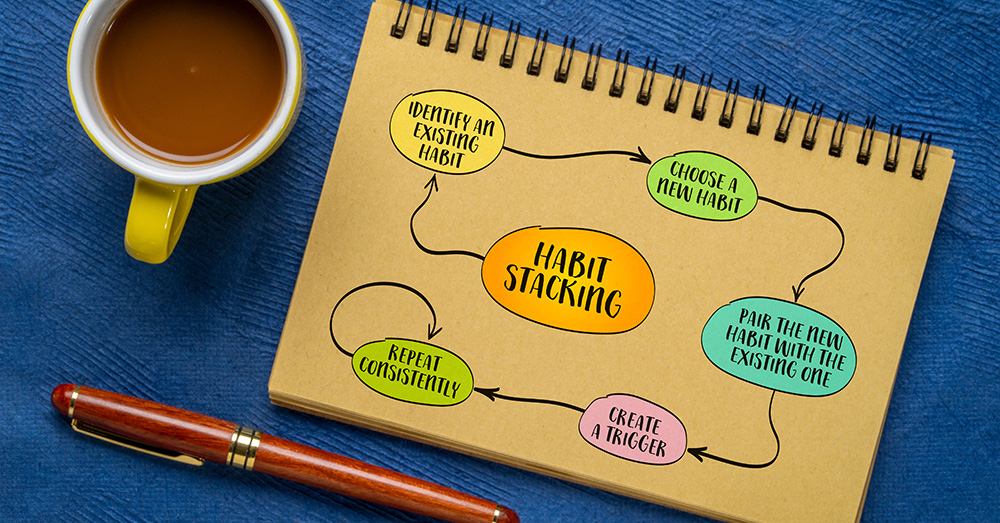
Habit stacking—attaching a new behaviour to an existing one—is one of the most reliable ways to build lasting change. But most people do it wrong. They pick the wrong anchor, make the new habit too big, or ignore the context that makes the stack stick. This article shows you how to build habit stacks that actually survive beyond the first week of enthusiasm.
What Habit Stacking Actually Means
Habit stacking was popularised by James Clear in Atomic Habits, but the concept is older. It works because your brain already runs on automatic routines. Brushing your teeth, making coffee, checking your phone—these happen without conscious decision. By linking a new behaviour to an established one, you borrow the existing neural pathway instead of building a new one from scratch.
The formula is simple: After I [CURRENT HABIT], I will [NEW HABIT]. After I pour my morning coffee, I will drink a glass of water. After I sit down at my desk, I will write my top three priorities. The existing habit becomes the trigger. The new habit becomes the response.
But simplicity is deceptive. The difference between a stack that lasts and one that collapses lies in the details most people skip.
The Three Rules of a Strong Anchor
Not every existing habit is suitable for stacking. A weak anchor produces a weak stack. Your anchor habit must meet three criteria.
First, it must happen with consistent frequency. If your anchor only occurs on Tuesdays, your new habit will also only occur on Tuesdays. Daily anchors are strongest. Weekly anchors can work but require more reinforcement. Choose something you do every day.
Second, it must have a clear endpoint. “After I wake up” is too vague. Waking up is a process, not a moment. “After I turn off my alarm” is specific. “After I close my laptop” is specific. The anchor needs a definite action that signals the stack to begin.
Third, it must match the desired context. If your new habit requires focus, don’t stack it on an anchor that happens in a chaotic environment. Don’t anchor it to your morning commute if it requires quiet. The physical and emotional context of the anchor must support the new behaviour.
Why Most Stacks Fail
Even with a strong anchor, habit stacks collapse for predictable reasons. Understanding these failures helps you avoid them.
The new habit is too large. “After I pour my coffee, I will meditate for thirty minutes” sounds reasonable until morning arrives and you’re running late. The correct version is “After I pour my coffee, I will meditate for sixty seconds.” One minute is ridiculous. That is the point. It is too small to resist. Once the minute is automatic, you can expand it. But expansion comes later, after the stack is cemented.
The stack lacks a physical reminder. Your brain forgets new intentions under stress. A visible cue—a post-it on the coffee maker, a water bottle on the bathroom counter, or a book on your pillow—bridges the gap between intention and action. The cue should appear exactly where the anchor happens.
The environment fights the habit. If you stack stretching on “after I wake up” but your yoga mat is buried in a closet, friction wins. Reduce the steps between anchor and action to one. Unroll the mat the night before. Fill the water bottle in advance. Remove every obstacle between the trigger and the behaviour.
Building Your First Stack: A Practical Walkthrough
Let’s build a real stack from start to finish. Suppose you want to start a gratitude practice.
Step one: Choose your anchor. You drink coffee every morning. The pot finishes brewing at 6:45 AM. The endpoint is clear: “After I pour my first cup of coffee.”
Step two: Define the new habit precisely. Not “practise gratitude”. That is abstract. The specific behaviour is “Write one sentence about something I appreciated yesterday.” One sentence. Not a page. Not five minutes. One sentence.
Step three: Prepare the environment. Place a small notebook and pen directly beside the coffee maker. Not near it. Besides it. The notebook should be the first thing you see after pouring.
Step four: Execute for seven days without evaluation. Do not judge the quality of your sentences. Do not skip because you “don’t feel grateful today”. The goal is not to have good gratitude. The goal is a reliable stack.
Step five: Expand only after consistency. After two weeks of daily one-sentence entries, expand to three sentences. After a month, you should expand this into a full paragraph. The foundation must be solid before you add weight.
Stacking Multiple Habits: The Chain Method
Once a single stack is automatic, you can chain additional habits onto it. This creates a sequence that runs without conscious effort.
A morning chain might look like this: After I turn off my alarm, I drink a glass of water. After I drink the water, I stretch for two minutes. After I stretch, I make coffee. After I pour the coffee, I write my priorities. Each habit becomes the anchor for the next. The chain grows one link at a time.
The danger is adding links too quickly. A chain with four new habits is fragile. A chain with one established habit and one new habit is strong. Wait until the newest link feels automatic before adding the next. Patience is not delay. It is structural integrity.
When to Break and Rebuild a Stack
Sometimes a stack that worked stops working. Life changes. Schedules shift. The anchor habit disappears. When this happens, don’t force the old stack. Please dissolve it and build a new one.
If your morning coffee anchor fails because you switch to tea, find a new anchor. If your evening stack collapses because your work hours change, redesign around your new reality. Habit stacks are tools, not contracts. They serve you. You do not serve them.
The rebuild follows the same rules: strong anchor, tiny habit, clear cue, supportive environment. The process is not failure. It is maintenance.
The Mindset That Makes Stacking Stick
Habit stacking is not a hack. It is not a trick to bypass discipline. It is a recognition that willpower is finite and the environment is powerful. When you design your surroundings to make good habits automatic, you stop relying on motivation and start relying on structure.
The right way to stack habits is slowly, specifically, and with deep respect for the anchor. The wrong way is ambitiously, vaguely, and with hope that enthusiasm will carry you through. Enthusiasm always fades. Structure remains.
Pick one anchor today. Attach one tiny habit. Prepare the space. Execute for one week. That is how change begins—not with a grand declaration, but with a single, deliberate link between what you already do and what you want to become.
About the Author: At Vida Sana y Natural, we believe that small, intentional changes to your daily environment can lead to lasting improvements in well-being. Our articles blend practical home design with evidence-based wellness strategies to help you create a life that feels balanced, energised, and truly yours.
Related Articles
From Vida Sana y Natural
- Simple Ways to Stay Consistent with Healthy Habits
- How to Build Better Routines Without Feeling Overwhelmed
- Tiny Daily Changes That Improve Long-Term Well-Being
- Why “All or Nothing” Thinking Destroys Wellness Routines
- How to Design a Morning Routine Space That Actually Works
- Sustainable Self-Care Habits for Everyday Life
Recommended External Reading
- Habit Stacking: How to Build New Habits by Taking Advantage of Old Ones — James Clear
- Habit Formation — Psychology Today
